Average Reviews:

(More customer reviews)Are you looking to buy Kiev 1941: Hitler's Battle for Supremacy in the East? Here is the right place to find the great deals. we can offer discounts of up to 90% on Kiev 1941: Hitler's Battle for Supremacy in the East. Check out the link below:
>> Click Here to See Compare Prices and Get the Best Offers
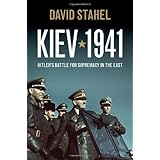
Kiev 1941: Hitler's Battle for Supremacy in the East ReviewAuthor David Stahel's book "Kiev 1941: Hitler's Battle for Supremacy in the East" is one of the few ... perhaps even only book in English ... to focus on the battle for Kiev in August - September 1941. I've always found this lack of a proper study of the battle to be surprising, given both the epic scale of the German victory/Soviet defeat and the fact that Hitler's decision to turn away from Moscow in August 1941 to deal with the Soviet armies around Kiev proved to be extremely controversial among his generals and historians of the war. In most works, this battle gets a few paragraphs at best before the run-up to Operation Typhoon, the German attempt to take Moscow.The book opens with an analysis of the strategic situation for both sides (including contributions by the western Allies) and examines the economic realities for the Germans. He then covers the internal discussions/struggles (both for the Soviets and Germans) that led to the Battle for Kiev. He then shifts into the fighting that occurred from late August until early October 1941. But Mr Stahel doesn't just cover the fighting around Kiev, he covers the fighting over the entire Russian Front (less the fighting in Finland), which is a good decision, as it shows how the Germans were having to frantically juggle their ever diminishing forces to try and accomplish their goals. It also shows that the Soviets were far from passive, and were trying to smash the Germans with significant counteroffensives in front of Smolensk and other places, and the need for troops to defeat these Soviet attacks further strained German resources and depleted their forces.
The author takes the fighting through the liquidation of the final pocket at Kiev and ends with the German forces poised, more or less, to begin Operation Typhoon. I say "more or less" because the fighting was so prolonged and distances to be covered by the German armies so vast, that many of the attacking forces weren't in position at the beginning of this offensive. He also shows that while the Germans won a historic victory, it was as much a matter of Stalin refusing to listen to his military advisors and pull his forces back from Kiev in time as it was the Germans winning the battle outright.
The tenet of Mr Stahel's analysis is that the Wehrmacht was wearing itself out (both mechanically and in terms of blood) faster than it could be replenished during Operation Barbarossa, and that the war's turning point had basically already occurred by August 1941, when the Germans failed to crush the Soviets in a quick campaign, and were forced into a battle of attrition. In a way, this book also addresses some of the criticisms of his earlier work, "Operation Barbarossa and Germany's Defeat in the East", which asked how the Germans could have already lost the war when they later won several smashing victories yet in 1941 at Kiev and at the twin battles of Vyazma and Bryansk, as well as in 1942.
The book is fairly German-centric, and by that I mean Mr Stahel primarily uses German records and reports to show how the Germans were being ground down even as they continued to win victories. There is a good coverage from Soviet side, mind you, but most of the analysis and descriptions are from the German point of view, which is in line with his showing of the steady deterioration of the German forces. There are over 20 photographs as well as 13 maps, most of which are from fellow-historian David Glantz's atlas of maps from the war. While the photographs are good, I can't comment much on the maps, as I'm reviewing this book from my Kindle, and the maps aren't large enough to really see much detail. However, if you're read anything from David Glantz, you're familiar with the layout and quality of these maps, which are generally very good albeit with a few weaknesses.
As the author notes in his introduction, this book can be viewed as a continuation of his above-mentioned book or as a study on the Battle of Kiev. Mr Stahel has an interesting and succinct writing style, and he presents his arguments clearly and persuasively. While I don't entirely agree with him that the Germans had irrevocably lost the war on the eastern front by August/September of 1941 (I personally think the Germans had a window of opportunity into 1942 to win a favorable peace with the Soviets), I don't disagree with his analysis of what was happening to the Germans during this time frame. I greatly enjoyed this book and found his analysis well-done and it added to my understanding of what was happening during this part of the war in the east. Five stars.
Kiev 1941: Hitler's Battle for Supremacy in the East Overview
Want to learn more information about Kiev 1941: Hitler's Battle for Supremacy in the East?
>> Click Here to See All Customer Reviews & Ratings Now

0 comments:
Post a Comment